Outdoor lighting isn’t just about making places look nice. It keeps your business visible, accessible, and safer once the sun goes down—even more so for factories, warehouses, and commercial properties. They need good lighting around entrances and boundaries. Parking lots and walkways shouldn’t be left in the dark. And let’s not forget private roads or big industrial sites; dependable lighting there keeps everything running smoothly.
But putting in traditional street lights is no small feat. You’re dealing with electrical wiring, digging trenches, connecting to the utility grid—and paying ongoing electricity bills. If your project covers a huge area or sits far away from a power supply, those headaches multiply.
That’s where standalone solar street lights in Bangladesh step in. They offer a smarter way to keep things lit.
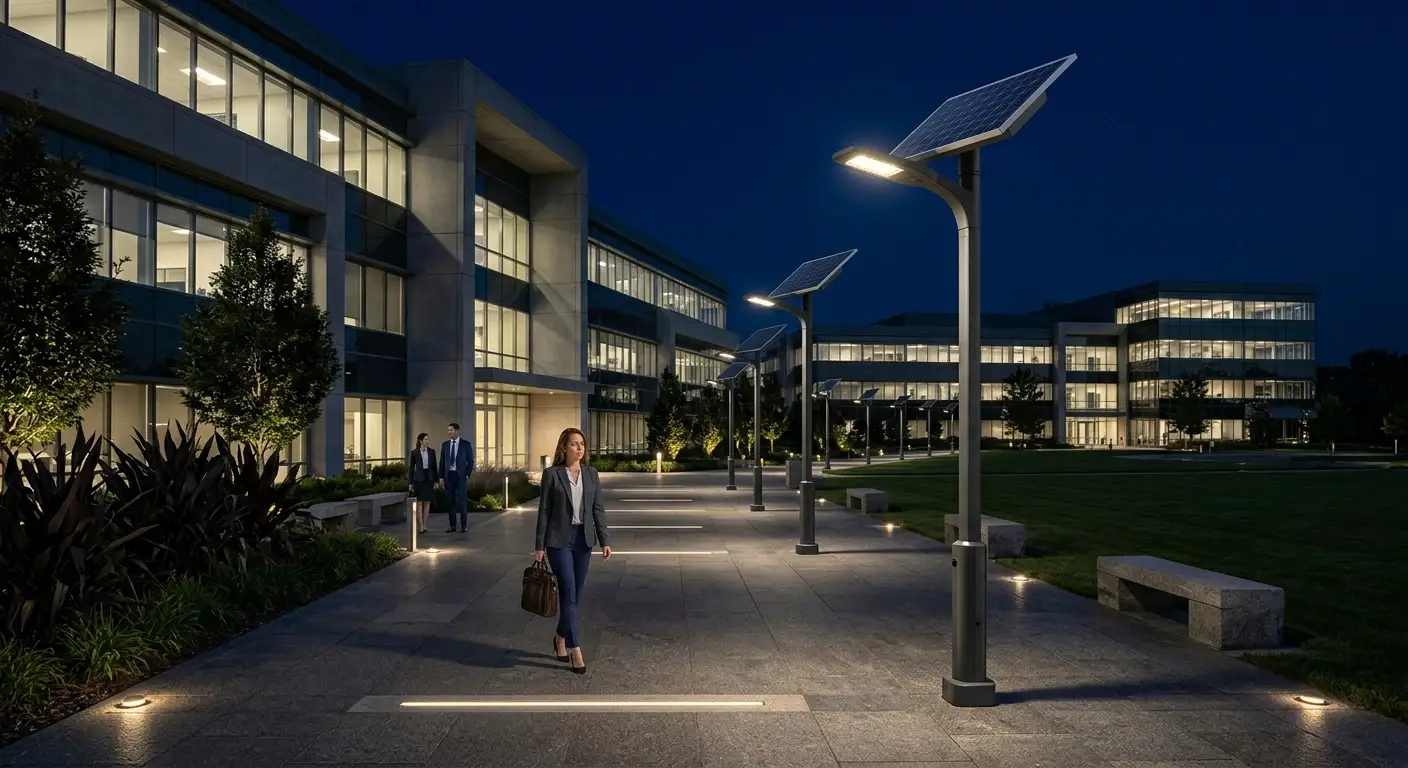
Standalone solar street lights run on sunlight. They don’t need your site connected to the grid. Everything’s built into one unit: a solar panel, a rechargeable battery, LED light, and a controller. You stick it where you need it—no fussing with wires underground.
In Bangladesh, this isn’t just theory. You can use solar street lights for factories, commercial spots, residential developments, warehouses, private roads, or rural locations off the beaten path. Whether you’re running a corporate campus in Dhaka, managing a warehouse near Chattogram, overseeing an industrial site in Gazipur, or a commercial property in Sylhet, understanding the basics of solar street lighting helps you make smarter choices.
This guide breaks down standalone solar street lights. It covers how they work, their perks, how to install them, what they cost, maintenance, and what to look out for—tailored for businesses in Bangladesh.
What is a standalone solar street light?
It’s an outdoor lighting system that makes and stores its own electricity from sunlight. Unlike typical street lights tied to the power grid, standalone solar lights soak up sun during the day, store that energy in a battery, and run the LED light after dark. “Standalone” means just what it sounds like—it works without the regular electrical supply.
Most models bundle everything—the panel, battery, controller, and light—into one setup, but designs vary. You might line a road with solar street lights or add them to a warehouse entrance, no need to stretch wires out to every fixture. This turns out handy when grid access is limited or expensive to expand.
Here’s the gist: Solar street lights catch sunlight, store the energy, then use it to light up outdoor spaces when night falls.
How standalone solar street light actually work?
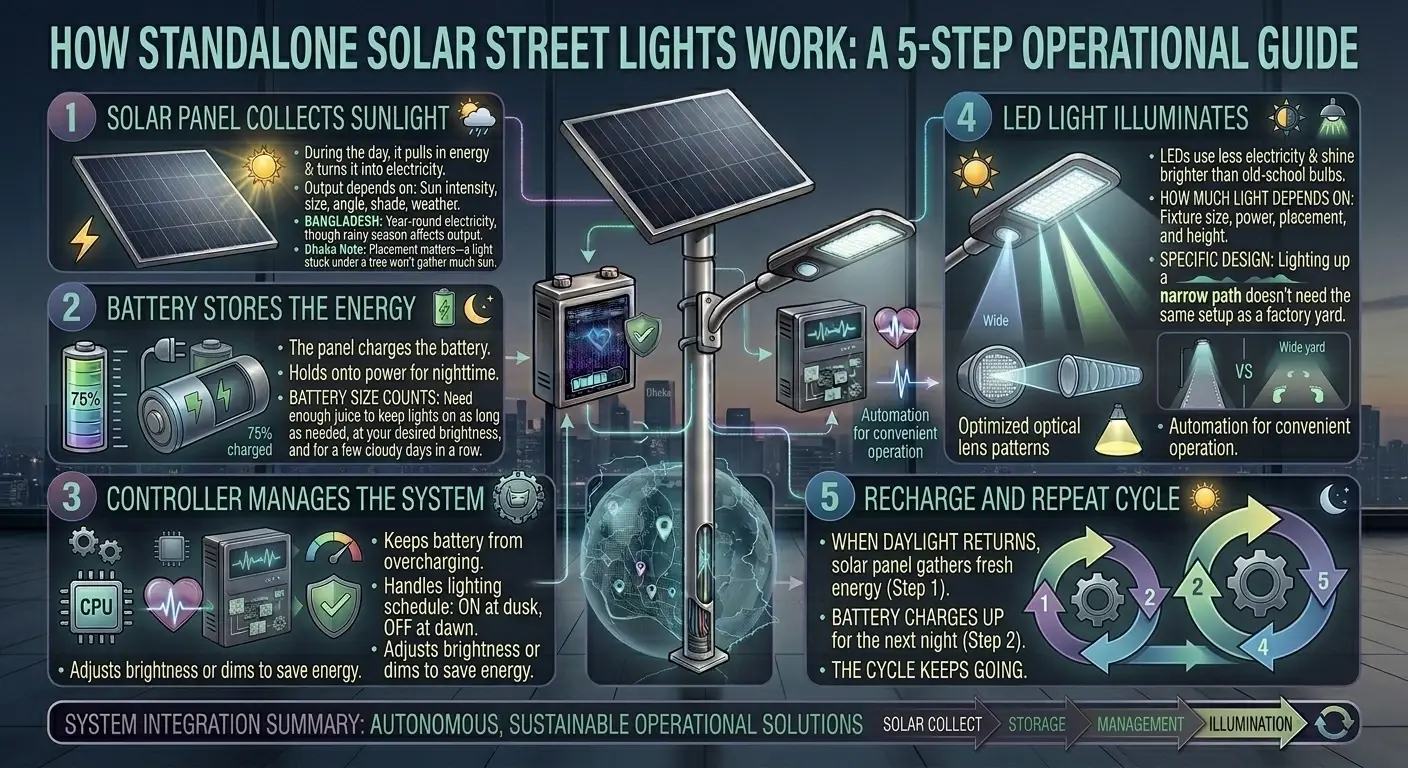
It’s pretty simple:
Step 1: The solar panel collects sunlight. During the day, it pulls in energy and turns it into electricity. Output depends on how much sun hits the panel, its size, angle, shade, and weather. In Bangladesh, you get solar electricity year-round, though rainy season affects output. Panel placement matters—a light in Dhaka stuck under a tree won’t gather much sun.
Step 2: The battery stores the energy. The panel charges the battery, which holds onto power for nighttime. Battery size counts—you’ll need enough juice to keep lights on as long as needed, at the brightness you want, and for a few cloudy days in a row.
Step 3: The controller manages the system. This chunk of tech keeps the battery from overcharging and often handles the lighting schedule—turns the lights on at dusk, off at dawn, adjusts brightness or dims to save energy.
Step 4: The LED light does the illuminating. LEDs use less electricity and shine brighter than old-school bulbs. How much light you get depends on the setup—the size of the fixture, power, placement, and height. Lighting up a narrow path doesn’t need the same setup as a factory yard.
Step 5: Recharge and repeat. When daylight returns, the solar panel gathers fresh energy. Battery charges up for the next night. The cycle keeps going.
But, reliability depends on enough sunlight, the right battery, and proper design for Bangladesh’s weather. Long cloudy stretches? A small system might run out of juice.
What’s inside a standalone solar street light?
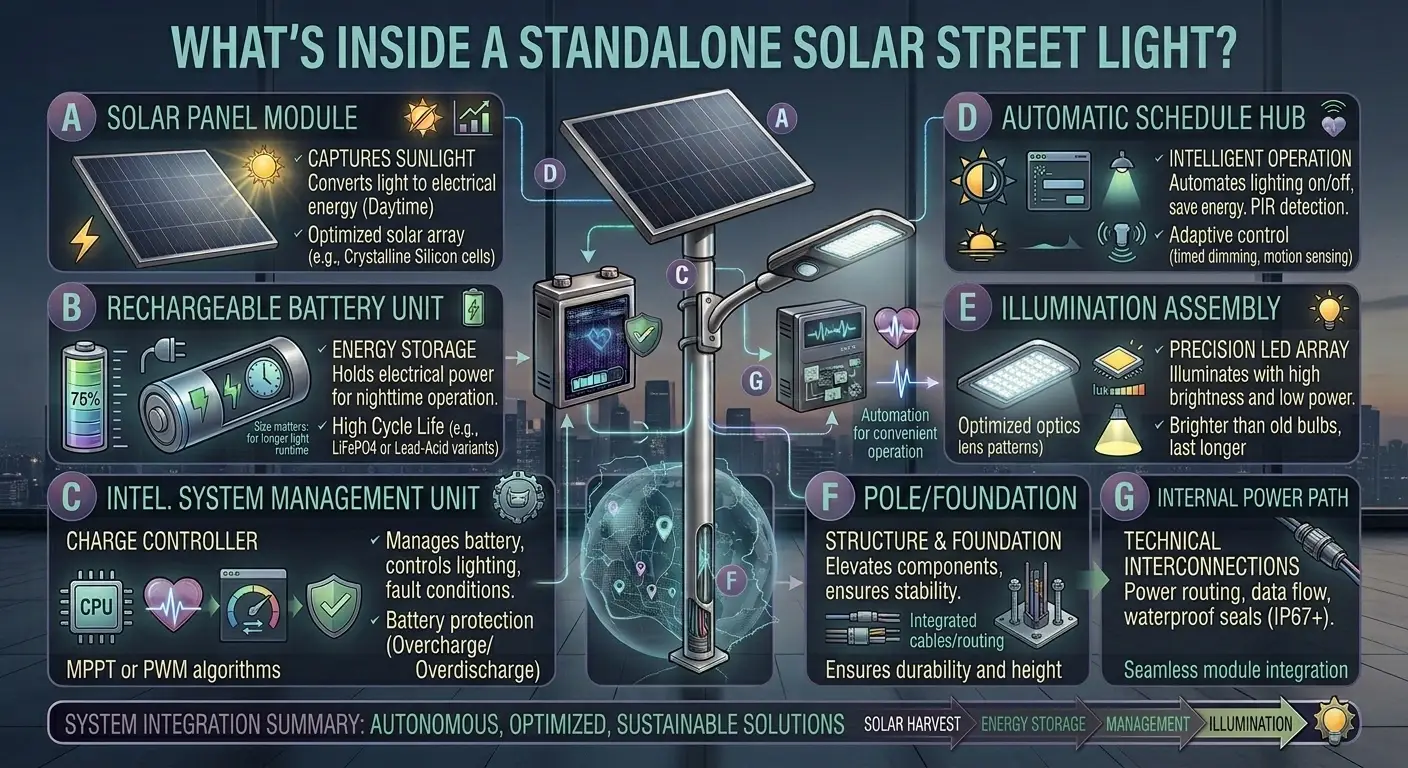
You need to know the main pieces, so you ask the right questions.
- Solar panel: Turns sunlight into electricity.
- Rechargeable battery: Stores electricity for nighttime.
- LED light: Illuminates the area.
- Charge controller: Manages the battery and protects the system.
- Pole/mounting: Holds everything up.
- Sensor/timer: Controls when the light comes on or off.
- Cables/connectors: Put it all together.
Designs differ. Some bundle everything into a compact unit. Others keep parts separate. Don’t judge by LED wattage or looks; check specs for the whole system before you buy.
Why should businesses in Bangladesh care?
The country’s full of commercial and industrial properties—big city offices, factories, logistics hubs, shopping centers, developments outside the urban hustle. Lighting needs vary. Sometimes hooking up to the existing grid is easy, but often, distance, underground obstacles, or costs make it tough.
Standalone solar street lights bring flexibility.
1. Factory and industrial premises
Factories need lights around entrances, roads, parking, loading zones, and boundaries. Solar street lights can go in spots where running new cables is a pain. Places like Gazipur, Ashulia, Savar, Narayanganj—site layout, safety needs, and environmental factors matter.
2. Commercial buildings and offices
Business parks, offices, and commercial developments want pedestrian paths, parking, landscaping, and entrances lit. Solar avoids running wires to every light. In areas like Gulshan, Banani, Uttara, Motijheel, sunlight and mounting space affect feasibility.
3. Warehouses/logistics
Out on big yards or loading docks, solar makes sense if extending electrical infrastructure is tough—but loading bays and high-traffic zones need careful planning. Get a supplier to check light levels before installing.
4. Rural and remote sites
Far from reliable electricity? Solar street lights work independently—handy for access roads, rural facilities, farms, remote business sites. Just make sure the system is sized for local sunlight, battery backup, and maintenance.
5. Real estate/property development
Developers might use solar for roads, walkways, parking, and landscaping. It’s attractive during planning, especially if grid connections aren’t set. But weigh total project design, maintenance, and lighting needs.
Benefits of standalone solar street lights
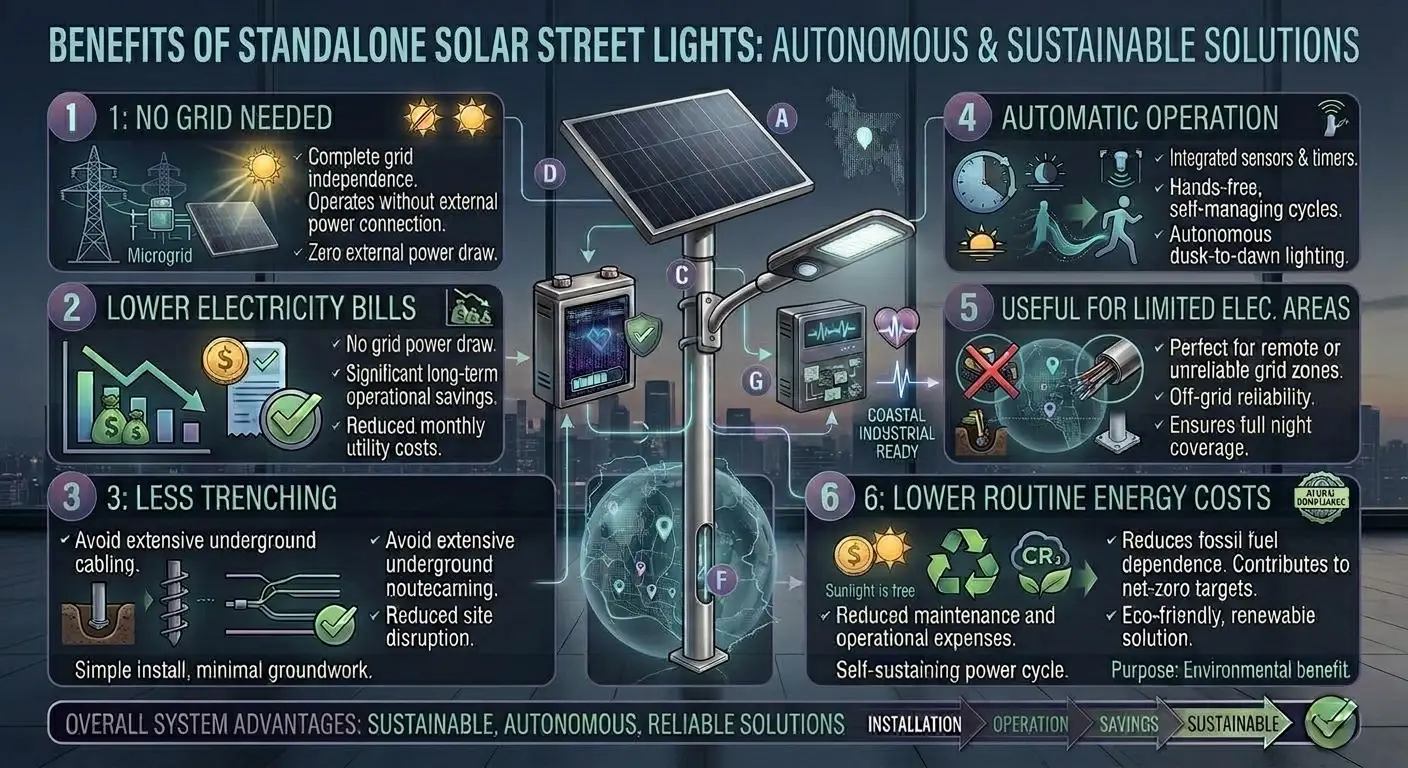
1. No grid needed
They run without grid electricity. That cuts down on extending cables, especially for properties with sprawling roads or isolated spots.
2. Lower electricity bills
They don’t use grid power (unless you go hybrid). That means cheaper operations over time. Of course, the real savings depend on purchase cost, battery replacement, maintenance, and how they perform.
3. Less trenching
You can skip some underground cabling—each unit powers itself. That avoids disruption along roads, boundaries, or landscaped areas. You’ll still need pole foundations and mounting, though.
4. Automatic operation
Most turn on/off by themselves, thanks to sensors or timers. That’s convenient—no need for manual switching. Always check what controls are included.
5. Useful for limited electricity areas
If grid extension isn’t feasible, these lights work anywhere with sunlight. Just make sure the system’s sized to the location.
6. Lower routine energy costs
Sunlight’s free. Once installed, you’ll spend less on day-to-day energy. But remember, batteries, LEDs, controllers, cleaning, and repairs aren’t free, so set a realistic maintenance budget.
7. Supports sustainability goals
More businesses care about energy efficiency. Using solar for outdoor lights cuts dependence on grid power (especially if the grid is fossil-fuel heavy). The environmental payoff depends on manufacturing, lifespan, upkeep, and battery disposal. Don’t skip proper battery recycling.
Are they suited to Bangladesh’s weather?
Yes, but choose carefully.
Bangladesh gets hot weather, seasonal rain, humidity, and cloudy spells. These affect solar generation and equipment durability.
- Rainy season/cloudy days: Panels still generate electricity, but less so. Ask the supplier about performance during long cloudy periods and how long the battery lasts without sun (that’s “battery autonomy”). For Bangladesh, it matters.
- Heat/humidity: High temps can hit battery life. Use gear rated for local conditions and follow installation advice.
- Rain/water: Outdoor units need solid waterproof ratings (“IP rating”) for rain, dust, moisture. Not every “waterproof” label means the same thing.
- Wind/storms: Poles and mounts should handle local wind. Check with suppliers about mounting arrangements, not just the light itself.
How to pick the right solar street light
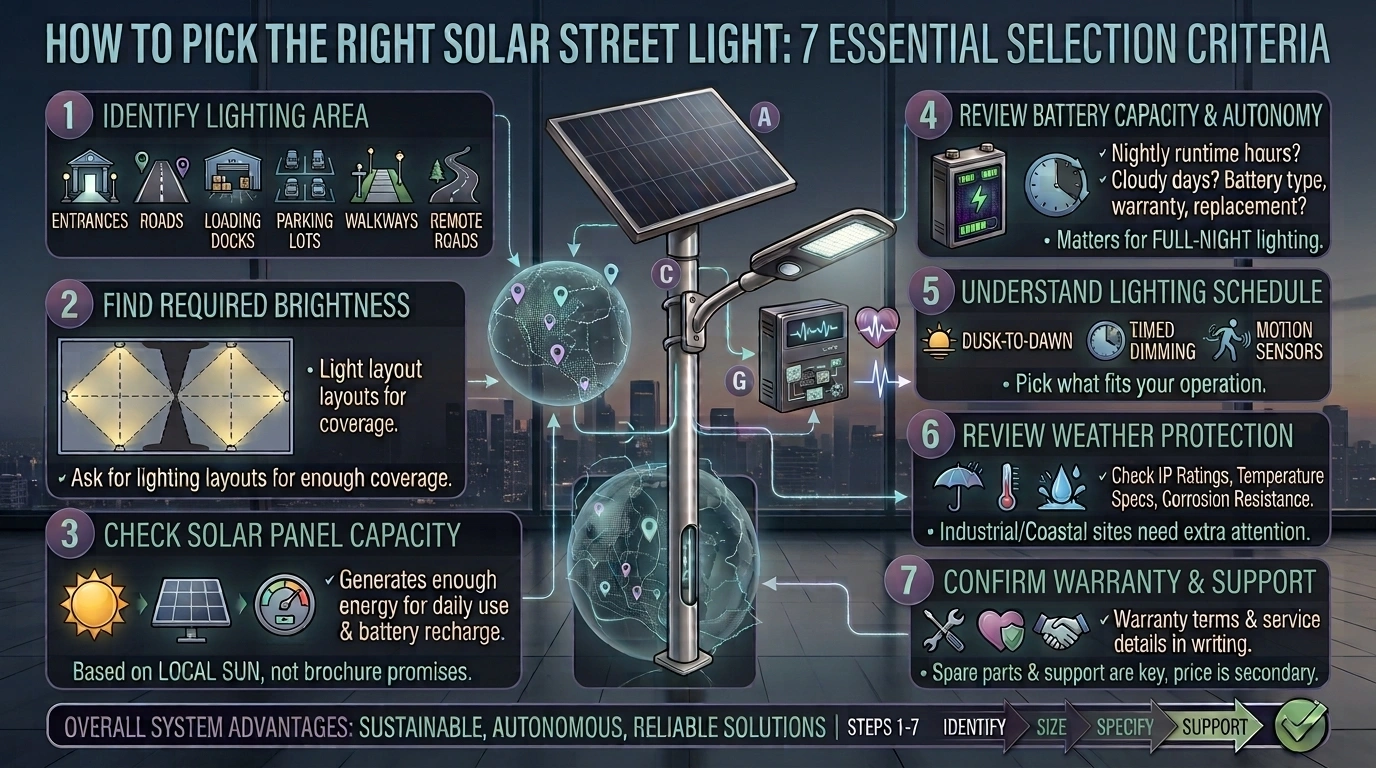
Don’t just grab the biggest wattage for the cheapest price. Match the system to your site’s lighting needs and conditions.
Here’s how:
- Identify where you need light—entrances, roads, loading docks, parking lots, walkways, remote roads.
- Find out what brightness you actually need. Ask for lighting layouts to ensure enough coverage and no dark gaps.
- Check solar panel capacity. Make sure it generates enough energy for daily use and battery recharge—based on local sun, not brochure promises.
- Review battery capacity and autonomy. Ask: How many hours does it run nightly? How many cloudy days can it handle? What battery type, warranty, and replacement options are there? This matters for full-night lighting.
- Understand the lighting schedule. Dusk-to-dawn, timed dimming, motion sensors? Pick what fits your operation.
- Review weather protection. Check IP ratings, temperature specs, corrosion resistance. Industrial/coastal sites need extra attention.
- Confirm warranty and after-sales support. Price is meaningless if you can’t get spare parts or support. Get warranty terms and service details in writing.
Solar Street Light Installation in Bangladesh: A Step-by-Step Guide
Getting your solar street lights installed the right way is key to making sure they work well and last. If you’re handling a big commercial job, it makes sense to bring in experienced professionals who know the equipment and keep things safe onsite.
Step 1: Site Survey
Start by checking out where you want to install the lights. Look for:
- Where the lights should go and how many you’ll need
- How much sunlight the area gets—and what things might cast shade
- The width of roads, walkways, and other routes
- Any underground cables or utilities
- Where your poles can go
- Soil conditions and solid spots for foundations
- Anything nearby—buildings, trees, or other things that could cause problems
In places like Dhaka, Gazipur, Narayanganj, and Chattogram, tall buildings and dense development seriously impact where panels get sunlight. A thorough site survey finds these issues early.
Step 2: Lighting Layout
After your survey, sketch out where the poles should be and what area each light will actually cover. Don’t just use a supplier’s standard brochure for pole spacing—it usually isn’t right for your specific spot. Base those decisions on real details like light spread, pole height, how wide the area is, and how much light you need. A site-specific plan makes it easier to see what you’re getting and to compare quotes side-by-side.
Step 3: Choose Your Equipment
Pick a whole system—panel, battery, LED, controller, pole, and mounts—that fits your project’s needs. Check technical specs and warranty conditions carefully, especially if you’re considering a few different options. Compare their numbers honestly.
Step 4: Foundation Work
Your pole foundation needs to match the site’s soil, the size and weight of your poles, and the area’s wind conditions. Let someone with proper know-how design the foundation plan. Before you start digging, check for underground utilities and get all necessary permits.
Step 5: Install Pole and Lights
After building the foundation, follow the manufacturer’s instructions to mount poles and lighting equipment. Make sure the solar panels are set up to catch as much sunlight as possible, avoiding shade as much as you can. The install team should bolt down everything solidly and make sure it all stands up to the local climate.
Step 6: Wiring and Configuration
Wire up all components as shown in the manufacturer’s diagram. Set up the controller, battery, and LED lights for the operating schedule you want. This might include automatic switching, adjusting brightness, or setting other energy-saving features.
Step 7: Testing
Inspect everything before saying the work is done. Check charging indicators, light controls, battery status, mounting stability, and if the automatic modes work. Make sure the lit area is right for what’s needed.
Step 8: Documentation
Keep a record of all the equipment used, locations, model numbers, warranty terms, instructions, and a maintenance plan. This helps you keep track of servicing and makes replacement simple later.
How Much Do Standalone Solar Street Lights Cost in Bangladesh?
Costs swing a lot based on specs and what your project needs. There’s no one-size-fits-all price. A basic model for a small area will cost way less than a heavy-duty system for an industrial site. Here’s what usually affects price:
- Solar Panel & Battery
Bigger energy demands or longer runtime need larger panels and batteries. Battery type and size, lifespan, and warranty also matter. - LED & Lighting Design
Light output, how the light spreads, system efficiency, and timing all play a role in picking equipment. Lighting up a big open area is nothing like lighting a narrow road. - Poles & Foundation
Pole height, material, the strength of the design, and how tough installation will be all affect cost. Hard-to-reach or tough ground can drive up labor and foundation expenses. - Installation & Transport
Labor, delivery, equipment handling, and prepping the site go into final pricing. Farther locations or sites outside big cities usually cost more to serve. - Warranty & After-Sales Support
Better warranties, easy-to-find replacement parts, and reliable support might cost more upfront but save headaches and money later. - Number of Units
Bigger projects sometimes get better pricing—depends on supplier, order size, and what’s actually included.
Tip: Always ask for a detailed, itemized quote. Make sure it includes the lighting unit, pole, foundation, installation, transport, warranty, and maintenance so you can really compare offers.
How to Evaluate Long-Term Value
For corporate buyers, price isn’t the only consideration. Think about the total cost over several years. For standalone solar lights, look at:
- Equipment
- Foundations and poles
- Installation and transport
- Cleaning and inspection
- Battery replacements
- Repair and component swaps
- Disposal of old batteries
If you’re comparing solar with standard grid-connected lights, factor in electricity bills, wiring, trenching, and maintaining electrical systems. Solar can look expensive at first but pay off when you avoid big infrastructure costs and regular energy bills. Still, the real savings depend on equipment cost, running time, upkeep, and local energy prices.
Ask suppliers to show their math—how they calculate payback and savings.
Common Mistakes To Avoid
- Focusing only on wattage: Higher wattage doesn’t always mean brighter or better. Look at the full system—light output, spread, battery and panel size, and run time.
- Forgetting the rainy season: If you only plan for sunny days, you’ll get dim lights when it’s wet out. Check for real data on cloudy and rainy performance.
- Overlooking shade: Anything that blocks sunlight—buildings, trees, signs—means less charging for your panels.
- Picking the cheapest without comparing details: Just because two options look alike doesn’t mean they are. Check battery capacity, warranty, weather protection, and component quality.
- Ignoring maintenance: Solar lights need regular cleaning and checking. Make sure you have a plan for periodic inspections and can easily find parts.
- Skipping the lighting layout: Wrong spacing or height creates uneven light. Always get a site-specific layout.
Maintenance Tips for Solar Street Lights in Bangladesh
Routine maintenance keeps your system reliable. Here’s a straightforward plan:
- Clean the Panels: Dust, grime, and birds mess can block sunlight. Check and clean as needed, especially if you’re near construction or industry.
- Check the Battery and Controller: Look at system signals. If your lights run shorter than expected or show faults, bring in a pro. Only open sealed batteries if it’s allowed and safe.
- Inspect Mounts and Poles: Look for rust, looseness, or damage—especially in places with tough weather.
- Night Performance: Make sure the lights come on and stay on as they should. If you see dim or early shut-off, investigate immediately.
- Keep Records: Log inspections, faults, fixes, replacement parts, and warranty issues. This way, you spot patterns and budget better for repairs.
Where to Use Standalone Solar Street Lights in Bangladesh
The best location isn’t just about being in a certain city—it’s about the actual site conditions.
Dhaka: Works for office campuses, factories, private roads, and parking lots. Just watch for tall buildings and shaded zones. A good survey matters.
Chattogram: Good for warehouses, internal roads, and industrial/commercial grounds. Coastal moisture makes corrosion resistance a must.
Gazipur & Narayanganj: Ideal for factories, boundary roads, parking, and outdoor areas—just account for dust, shadows, maintenance, and specific lighting levels.
Sylhet: Lighting for commercial buildings, schools, housing, and remote sites. Design with rainfall, cloudy spells, and enough battery backup in mind.
Rajshahi: Useful on commercial grounds, private roads, school grounds, or farms. Consider panel location, energy needs, and maintenance plans.
Khulna: Good for properties and warehouses—especially if you pay attention to waterproofing, solid mounts, and rust protection.
Cumilla, Mymensingh, Rangpur, Barishal: For factories, commercial zones, rural roads, and hard-to-reach places.
Tip: Give your supplier the real project details—location, area size, hours you need the lights on, and how many points you need covered—so they can propose the right solution.
Solar vs. Conventional Street Lights
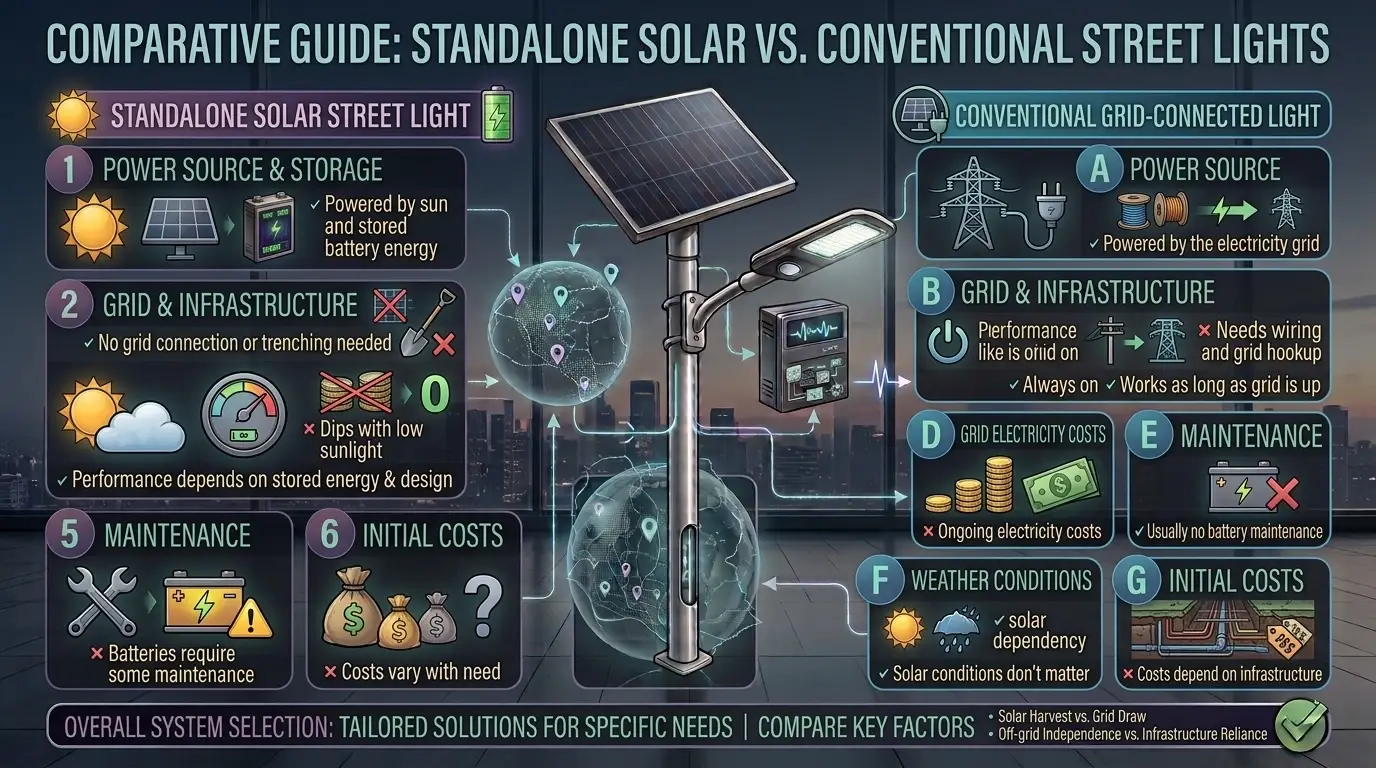
Which is best? Depends on your site.
Standalone Solar Street Light:
- Powered by sun and stored battery energy
- No need for grid connection or electrical trenching
- Performance depends on stored energy and design
- No grid electricity costs
- Batteries require some maintenance
- Performance dips with low sunlight
- Initial costs vary with need
Conventional Grid-Connected Light:
- Powered by the electricity grid
- Needs wiring and grid hookup
- Works as long as grid is up and running
- Ongoing electricity costs
- Usually no battery maintenance
- Solar conditions don’t matter for power
- Initial costs depend on electrical infrastructure
If you’ve got reliable grid power, conventional lights might suit you. If trenching wires is tough or costly—or if you want to go green—solar is worth considering. The best pick is the one that fits your needs for cost, reliability, and ease of upkeep.
FAQ: Standalone Solar Street Lights in Bangladesh
What is a standalone solar street light?
It’s an outdoor light system that generates electricity from a solar panel, stores power in a battery, and lights up at night—no grid needed.
How do they work?
Panels collect sunlight by day and charge the battery. The control unit manages charging and operation. At night, the battery runs the LED light.
Are they suitable for Bangladesh?
Yes, for many use cases—from factories and warehouses to private roads and commercial lots. Choose panels, batteries, and setups that match your location’s sunlight.
Do they work in the rainy season?
Yes, but the system will generate less electricity on cloudy days, so you need enough battery storage for longer stretches without sun.
How long do they run at night?
It depends—battery size, light power, brightness settings, and how well the system charges during the day. Ask the supplier for clear data, not just marketing talk.
Do I have to pay electricity bills?
Not for running the light if it’s fully standalone—just the upfront setup, maintenance, and future replacements.
Are they good for factories?
Definitely—as long as you match system size and lighting level to the local environment and operating needs.
Can I use them in Dhaka?
Yes, if your panels get enough sun (watch for shading). Great for compounds, parking, private lanes.
What should I check before buying?
Panel size, battery storage, expected run time, lighting area, weather protection, pole/foundation needs, warranty, availability of spare parts, and local support.
How much do they cost?
It depends on every part of the system and the project scale. Always ask for a detailed quote for your site.
Do they light up automatically?
Most do. Many models have sensors or programmable timers—double-check features before you buy.
How much maintenance do they need?
This varies by environment and model. Expect routine panel cleaning, occasional inspections, checking lights, mounts, and batteries.
Are they good for warehouses and parking lots?
If you get the design right, yes—just make sure the spread and brightness match your space so there aren’t dark patches.
Are solar lights better than conventional lights?
Not always. Solar is great for off-grid spots and cutting energy use; grid lights are better if grid power is solid and infrastructure is already in place. Compare full costs long-term.
Where can businesses use them in Bangladesh?
Pretty much everywhere—factories, offices, warehouses, roads, new developments, parking areas, and even remote sites.
Thinking about solar street lights for your business in Bangladesh? Here’s how to get moving. First, you need a solid grasp of your site and exactly what kind of lighting you need.
Before you even ask for a quote, gather this info:
- Where’s the project? Write down the city, area, and address.
- What’s the application? Is it for a factory, warehouse, office compound, parking lot, private road, or something else?
- Lighting requirements—describe the exact area you want lit up and how many hours it needs to run each night.
- How many lights? If you know, estimate the total number of points you’ll need.
- Site conditions. Note how much sunlight the place gets and mention any nearby buildings, trees, or obstacles.
- Project scope. Decide if you’re just buying equipment or if you want the full package—poles, foundations, installation, and testing.
- Support details. Find out about warranty, maintenance, replacement batteries, and after-sales service.
When you hand this over to a good supplier, they can check the site, suggest the right gear, and send you a quote.
If this is a corporate project, ask for a written proposal. It should lay out the specs they picked, expected performance, installation plans, warranty, and maintenance terms. Having all this makes it way easier to compare suppliers and pick a system that fits your needs.
Solar street lights are a solid alternative to traditional outdoor lighting in Bangladesh, especially for commercial and industrial sites. They soak up sun during the day and use that stored energy to light things up at night—no wired connection to the grid needed.
For factories, warehouses, offices, parking areas, private roads, and remote properties, solar street lights can cut down on grid power use and make electrical installation less of a headache.
But don’t think it’s just about grabbing a solar panel and an LED. There’s a lot more to reliable, long-term performance—like battery capacity, sunlight hours, coverage, weather protection, pole strength, proper installation, and dependable maintenance.
Wherever you’re planning—Dhaka, Chattogram, Gazipur, Narayanganj, Sylhet, Rajshahi, Khulna, or anywhere else—start by checking out your site and nailing down what you really need from your lights.
With proper planning and the right setup, standalone solar street lights make sense for any business keen on saving energy and simplifying outdoor lighting.
Ready to Light Up Your Project with Solar Power?
Share your project location, site details, and lighting requirements. Contact us today for a tailored standalone solar street lighting solution and a customized quote for your needs.